
By Sarah Jensen, Regional Food Systems Coordinator, FAN-NWO
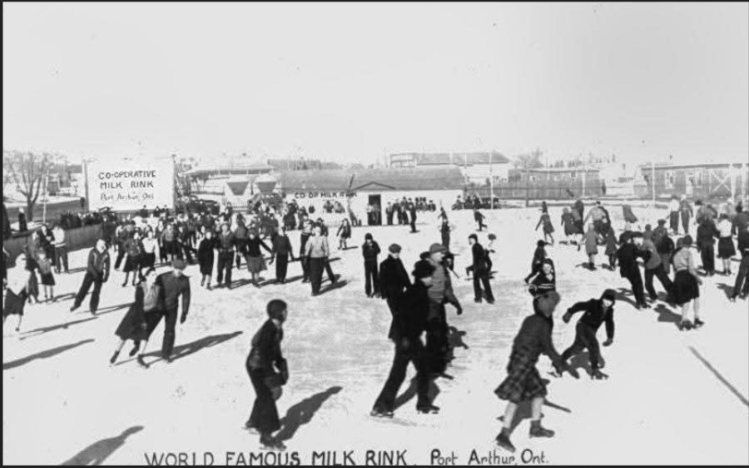
It’s winter 1939, and you’re about to head out for a fun new winter activity – skating on the Thunder Bay Dairy Co-op’s frozen-milk rink, made from surplus milk as a creative promotion for local dairy farmers. Nearly a decade earlier, those farmers – spurred by new pasteurization regulations – had come together to form the co-op, pooling resources to buy land and pasteurization equipment so that they could provide milk, ice cream, and yes, even ice rinks, to the local community. The Dairy Co-op remained in service for nearly 40 years.
Co-operatives are businesses or organizations owned and democratically controlled by people with shared needs. Member-owners each have one vote, shaping how profits are used, how the business operates, and how the co-op contributes to its community. Food and farm co-ops can take many forms, including food hubs, aggregation and distribution centres (like TB Dairy Co-op), farming supply stores, grocery stores, farmers networks, and so much more.
Common co-op structures include:
- Consumer co-ops, owned by the people who buy the goods and services offered.
- Worker co-ops, owned by the employees.
- Agriculture co-ops, often processor co-ops that collectively own processing equipment, or purchasing co-ops that bulk-buy supplies to reduce costs.
- Hybrid or multi-stakeholder co-ops, which combine two or more of these models.
Co-ops have played a major role in Canadian agriculture for more than a century. Between 1860 and 1900, more than 1,200 Canadian dairy co-ops were formed. In the early 1900s, grain growers established their first co-operatives, and the model continued to expand across food and farming sectors throughout the 20th century (Ian MacPherson, “The History of the Canadian Co-operative Movement”).
Northwestern Ontario has its own long history of co-operation, past and present. Some current examples include:
- 807 Food Co-op: an online local-food marketplace based in Dryden that gives farmers a shared sales platform and makes it easier for consumers to buy local (807foodcoop.ca).
- Thunder Bay Co-op Farm Supplies, founded in 1952 to combine members’ buying power and reduce the cost of farm supplies. They are located just off Hwy 61 on Boundary Drive (tbco-op.com).
- Finlandia Club & Hoito: established in 1918 as a worker co-operative, it runs the beloved Hoito restaurant (thehoito.com).
Looking forward, co-ops offer powerful tools for strengthening food systems in Northwestern Ontario and beyond. Rooted in the values of democracy, equality, equity, and solidarity, co-operatives prioritize people, planet, and profit, making them a resilient option for local economies, ecosystems, and communities. As Northwestern Ontario explores new ways to support local businesses and deepen community connections, co-ops present a promising path toward an even more vibrant, sustainable, and ethical regional food system.
Interest in developing new food and farm co-ops in Thunder Bay and across the region continues to grow. The Food Action Network is excited to support these conversations and expand education on co-operative models in food and agriculture.
If you would like to be a part of the conversation, email info@nwofood.ca with the subject line “Co-ops” and our Regional Food Systems Coordinator, Sarah Jensen, will be in touch. Watch out for our Food and Farm Co-op Roundtable coming in early spring 2026 at nwofood.ca or by following us on social media: @nwofood on Instagram, and @FANNWO on Facebook.
Photo credit to Thunder Bay Museum Archives.