By Sophie Shepherd, Rachel Johnson (Students, Lakehead University Masters of Environmental Studies), Dr. Charles Levkoe, Dr. Jill Taylor-Hollings & Dr. Martha Dowsley
For at least 7,000 years, Manomin has been cared for and cultivated by Indigenous Peoples throughout the Great Lakes watershed. Though the name “wild rice” is often used for this plant, it is misleading because it is neither wild, nor rice. It is an aquatic grass of the genus Zizania, distinct from true white rice of the genus Oryza. To label Manomin “wild” discounts the long-standing, reciprocal relationship through which Indigenous Peoples and Manomin have sustained one another. This relationship is at the heart of research partnerships between multiple Indigenous communities, including Obishikokaang (Lac Seul), Alderville and Mississauga First Nations and our Lakehead University team from Anthropology, Geography, and Health Sciences. Together, we aim to create a network for communities to share knowledge and practices to restore Manomin.
Among many Anishinaabeg communities, Manomin is known as the Good Berry, a name that speaks to more than nourishment alone. Historically, it has sustained communities, due to its many nutritional benefits. Traditional harvesting practices are grounded in sustainability, with care being taken to avoid overharvesting. Many communities hold the teaching that one third of the harvest is gathered for food, one third is left for waterfowl and other relations, and the remainder returns to the water to re-seed the plant.
However, colonial policies and industrial development in the Great Lakes region have disrupted this balance. Changing water levels and the introduction of pollutants have affected Manomin health, diminished vitality of plants and limited community access to this culturally significant food. For example, in Obishikokaang, the construction of a hydroelectric dam in the 1930s raised water levels in Lac Seul and destroyed thousands of acres of Manomin beds.
Our Lakehead University team aims to support Indigenous partners as they restore plant beds and renew relationships between people and Manomin. In this work, Manomin is not treated as an object of study, but as a relational being that guides ecological restoration and the renewal of community knowledge. We are committed to strengthening Indigenous food sovereignty by supporting gatherings for people to learn more about the revitalization of this culturally significant grain and training students whose projects help to address research questions about Manomin.
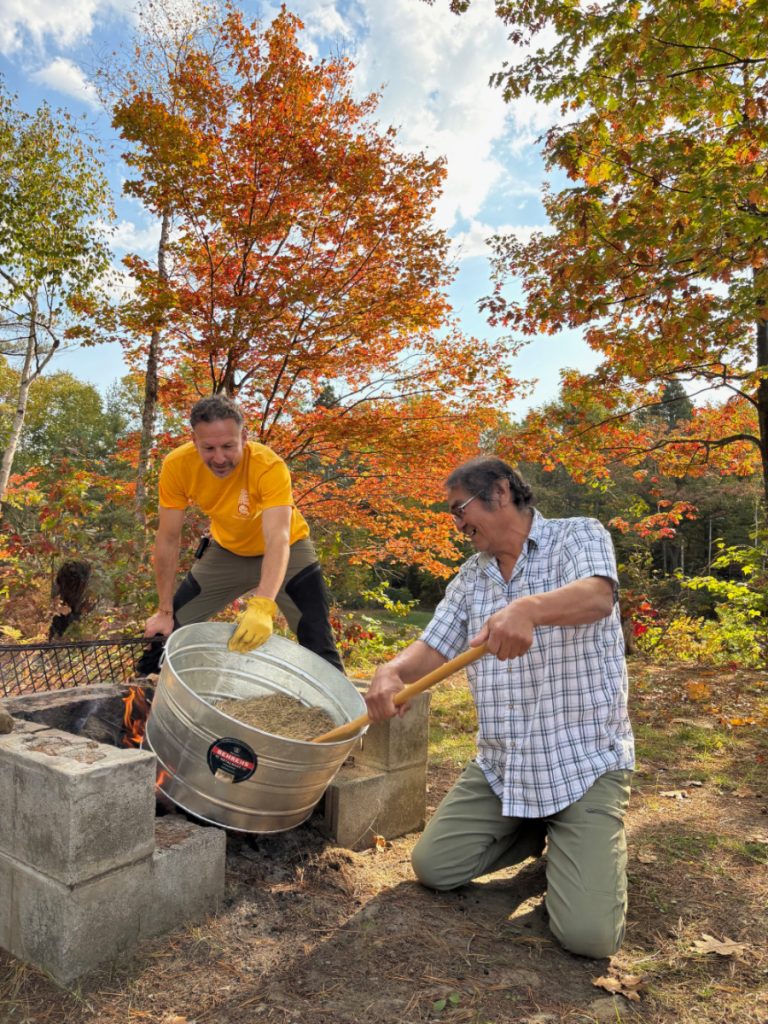
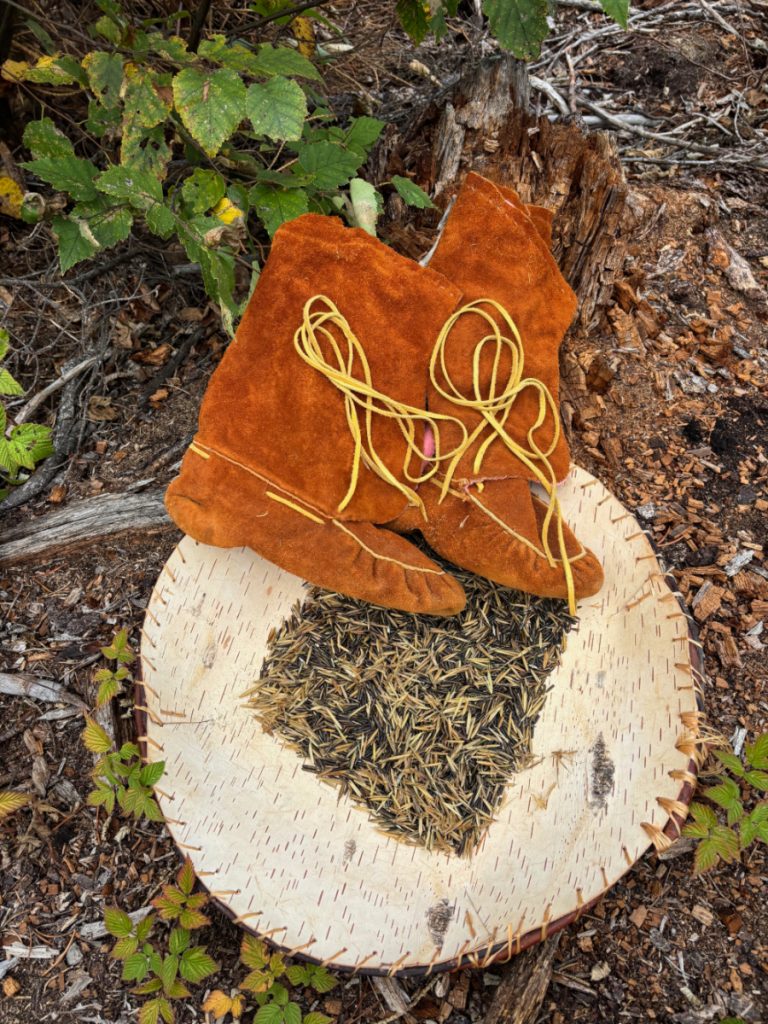
During the recent Manominike-Giizis (Manomin harvesting moon), in late August through September, we had the privilege of participating in harvesting and processing gatherings. Together with Obishikokaang Elders, Knowledge Holders, and other community members, we travelled to the shores of Lake Huron to Mississauga First Nation. Participants brought with them Manomin harvested from five different areas to be processed together using traditional methods to transform the harvested plant into edible grains. As pictured, the first step is to roast the plant over a fire in a large kettle. Next, the Manomin is placed into a lined pit in the ground, and gently danced upon while wearing new moccasins to separate the grain from the chaff. Lastly, it is tossed from a birch bark basket into the air, often over a blanket, to winnow the chaff from the edible portion.
These steps in Manomin preparation foster a cooperative environment that incorporates cultural traditions, the sharing of food and builds strong community bonds. The experience deepened our understanding of this labour of love required to nourish communities through traditional foodways. We enjoyed a variety of dishes, including Manomin soup with turkey sausage, cold Manomin sweetened with maple syrup and raspberries, and crispy Manomin egg fritters.
Manomin revitalization is not simply about restoring a food source, but about honouring Indigenous sovereignty, repairing Anishinaabe relationships with the land and water, and listening to the teachings of the Good Berry itself.
To learn more, please watch the short video “Manomin Dreams: The Restoration of Wild Rice at Lac Seul First Nation” (https://www.youtube.com/watch?v=MXgQm9h-qmE&t=3s ).